Blog Details
☆ From Blog
Blog Details
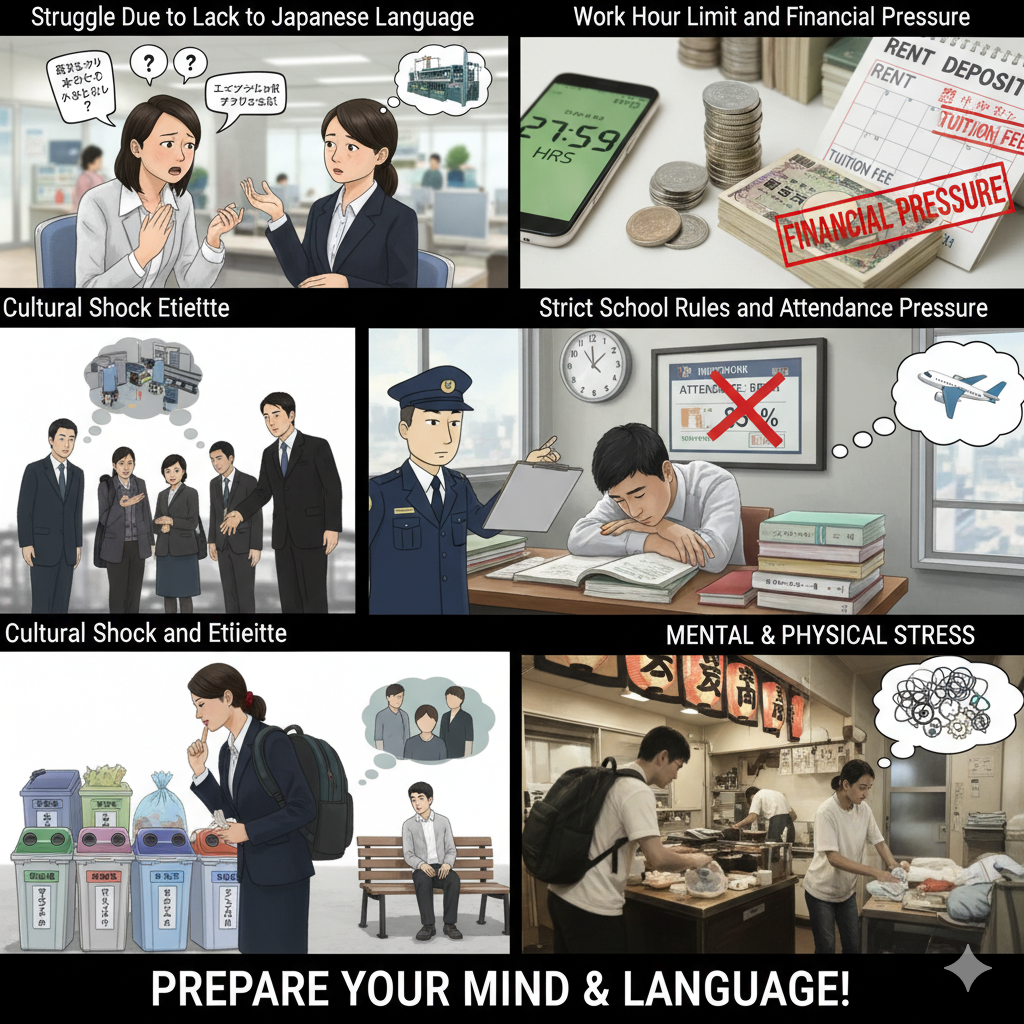
5 Major Challenges for Nepali Students Going to Japan
Students traveling from Nepal to Japan, especially those starting with language school, must be prepared to face the following five primary challenges:
1. Struggle Due to Lack of Japanese Language (Struggle Due to Lack of Japanese Language)
This is the biggest challenge of all.
- Problems in Daily Life: It becomes difficult to communicate with staff at the City Office, banks, hospitals, or supermarkets, as the majority of Japanese people do not speak English.
- Difficulty Finding Work: If you have not passed the Japanese Language Proficiency Test (JLPT) at N4 or N3 level, finding a Part-Time Job is extremely difficult. Even if a job is found, it may be physically demanding (e.g., factory work or cleaning).
- Low Wages: Due to a poor command of Japanese, you are often limited to jobs without direct customer contact, which results in lower wages and limits career advancement opportunities.
2. Work Hour Limit and Financial Pressure (Work Hour Limit and Financial Pressure)
- 28-Hour Limit: Students on a visa are legally permitted to work a maximum of 28 hours per week.
- The Challenge: The high cost of living in Japan and the fees for language school must be managed with this limited income. Many students are forced to work beyond this limit, which puts their visa renewal at risk.
- Initial Expenses: Upon arriving in Japan, you must manage initial costs like rent deposits, "key money," and other start-up expenses. Finding a job can take some time, so you should arrive with sufficient financial preparation for the first 2-3 months.
3. Strict School Rules and Attendance Pressure (Strict School Rules and Attendance Pressure)
- Strict Attendance: Japanese Immigration takes student attendance extremely seriously. You must maintain an attendance rate of at least over 90%.
- Consequences: If your attendance drops, your Visa Renewal may be denied, potentially forcing you to return to Nepal. The pressure of attendance can be stressful even when you are sick.
- Homework Load: Language schools demand daily homework and have frequent tests. Students face the double burden of focusing on studies even after being tired from a part-time job.
4. Cultural Shock and Etiquette (Cultural Shock and Etiquette)
- Complexity of Etiquette (Keigo): Japanese language has complex honorifics (Keigo) and formal etiquette that must be used in work and school settings. Learning and applying these rules daily is very challenging.
- Isolation and Friendship: Japanese people often value privacy in their personal lives. Forming deep and close friendships takes time, which can lead to feelings of isolation in the initial days.
- Rules: Daily rules, such as correctly sorting and disposing of garbage, and maintaining quiet and polite behavior with neighbors, are very strict.
5. Mental and Physical Stress (Mental and Physical Stress)
- The Daily Grind: The schedule of going to school in the morning, straight to work afterward, and returning late at night (school → work → home) makes it difficult to get sufficient rest.
- Health: Balancing work and study leads to increased mental stress. Long hours of standing or engaging in physically demanding jobs can negatively affect health.
Best Solution: The optimal solution for these challenges is to be mentally prepared before coming to Japan and to achieve the maximum possible proficiency in the Japanese language beforehand.
Recent Blogs

🇯🇵जापानी भाषा सिकौँ, जापान जाने सपना साकार पारौँ! 🌸
January 25, 2026

How Curry Day is celebrated in Japan like this
January 22, 2026

Are you preparing to go to Japan on a Student Visa or SSW Visa? If you are looking for high-quality Japanese language classes, look no further!
January 21, 2026
Here are the key strengths and positive aspects of Sabi Education Group
January 20, 2026
Services
Working Hours
- Sunday: 7 AM to 5 PM
- Monday: 7 AM to 5 PM
- Tuesday: 7 AM to 5 PM
- Wednesday: 7 AM to 5 PM
- Thursday: 7 AM to 5 PM
- Friday: 7 AM to 5 PM
Contact Us
OFFICE :
- Bharatpur
- Ratnanagar
Copyright © 2025 Sabi Education Group. All rights reserved
Powered by Dipesh Chaudhary